
In 2026, football is no longer just a playable sport on grass. It is a multi-billion-dollar theatrical experience. As we approach the kickoff of the 2026 FIFA World Cup, the infrastructure supporting the “beautiful game” has reached astronomical heights.
Watching a match live is an assault on the senses, and often on the wallet, as clubs and cities invest in “smart” venues that double as architectural marvels. And that’s what gives rise to the most expensive football stadiums that stunned the world.
Top 20 Most Expensive Football Stadiums as of 2026
| Rank | Stadium | Location | Primary Soccer Tenant | Capacity | Cost (USD) |
|---|---|---|---|---|---|
| 1 | SoFi Stadium | USA | 2026 World Cup Host | 70,240 | $5.5 Billion |
| 2 | Allegiant Stadium | USA | 2026 World Cup Host | 65,000 | $1.9 Billion |
| 3 | MetLife Stadium | USA | 2026 World Cup Final Host | 82,500 | $1.7 Billion |
| 4 | Mercedes-Benz Stadium | USA | Atlanta United (MLS) | 71,000 | $1.6 Billion |
| 5 | Wembley Stadium | UK | England National Team | 90,000 | $1.5 Billion |
| 6 | Santiago Bernabéu | Spain | Real Madrid | 81,000 | $1.5 Billion |
| 7 | Spotify Camp Nou | Spain | FC Barcelona | 105,000 | $1.45 Billion |
| 8 | Tottenham Hotspur Stadium | UK | Tottenham Hotspur | 62,850 | $1.33 Billion |
| 9 | Singapore National Stadium | Singapore | Singapore National Team | 55,000 | $1.31 Billion |
| 10 | Levi’s Stadium | USA | 2026 World Cup Host | 68,500 | $1.3 Billion |
| 11 | Krestovsky Stadium | Russia | Zenit Saint Petersburg | 68,000 | $1.1 Billion |
| 12 | Olympic Stadium | Canada | CF Montréal | 61,000 | $1.1 Billion |
| 13 | Optus Stadium | Australia | Australia National Team | 61,244 | $1.1 Billion |
| 14 | U.S. Bank Stadium | USA | International Host | 66,860 | $1.06 Billion |
| 15 | Estádio Nacional | Brazil | Brazil National Team | 72,788 | $900 Million |
| 16 | Emirates Stadium | UK | Arsenal FC | 60,704 | $850 Million* |
| 17 | Allianz Arena | Germany | Bayern Munich | 75,000 | $800 Million* |
| 18 | Everton Stadium | UK | Everton FC | 52,888 | $750 Million |
| 19 | Cape Town Stadium | South Africa | Cape Town City FC | 64,100 | $600 Million |
| 20 | Rogers Centre | Canada | 2026 World Cup Host | 53,506 | $570 Million |
From the high-tech hubs of the United States to the historic cathedrals of Europe undergoing billion-dollar face-lifts, here are the top 20 Most Expensive Football Stadiums in the World as of 2026.
1. SoFi Stadium (Inglewood, USA) – $5.5 Billion
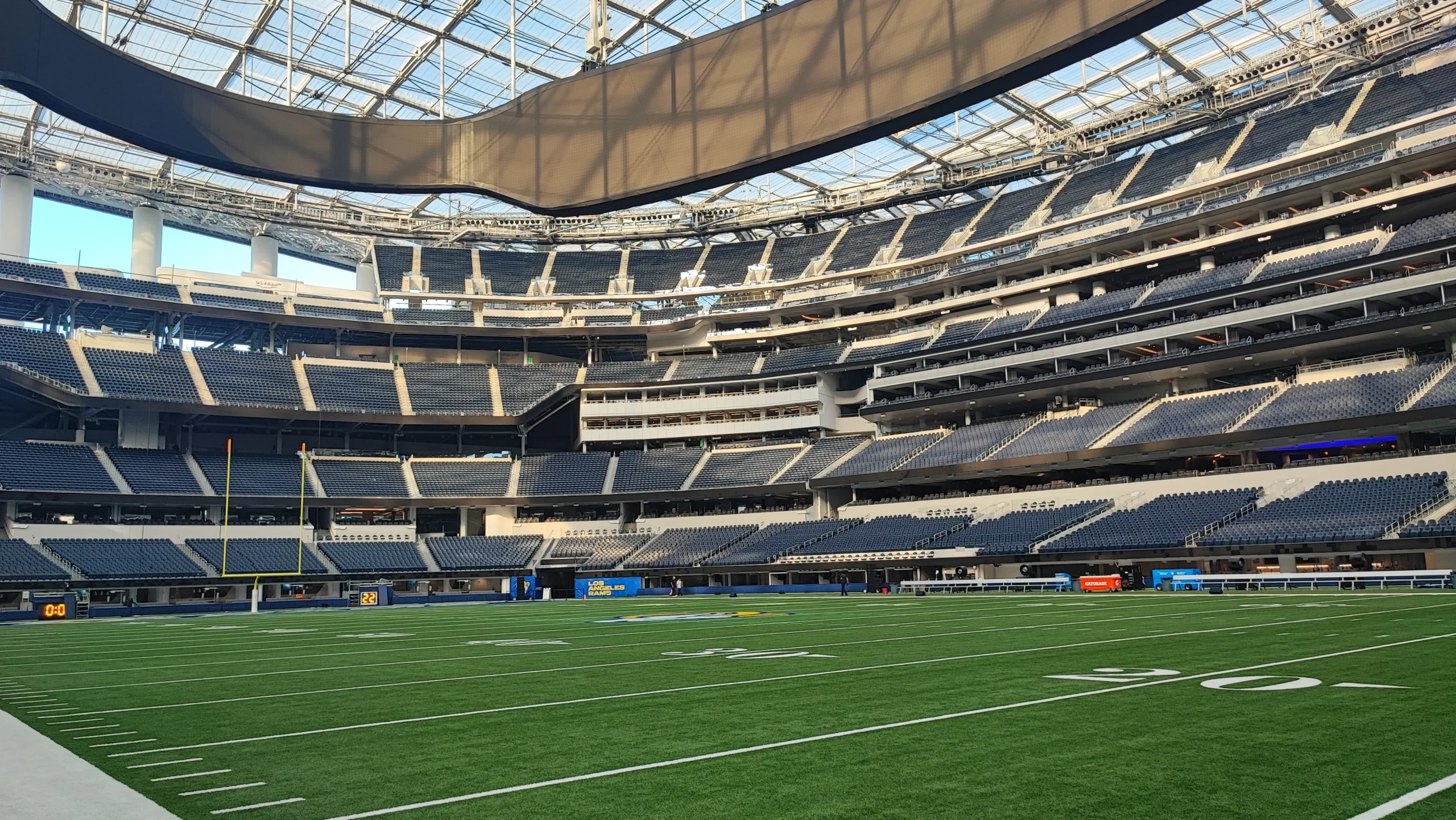
SoFi Stadium is not just a building. It is a self-contained city. Built with a staggering $5.5 billion investment, it serves as a primary hub for the 2026 World Cup. Its most striking feature is the “Infinity Screen,” a dual-sided, 2.2-million-pound 4K video board that wraps around the entire stadium.
For soccer, SoFi is an engineering marvel. Because the stadium was originally built slightly narrow for American football, engineers had to design a modular seating system to widen the corners, allowing for a full-sized FIFA-standard pitch.
The translucent, seismically-isolated roof creates an indoor-outdoor feel while protecting 70,000+ fans from the California sun, making it the most technologically advanced stage in soccer history.
2. Allegiant Stadium (Las Vegas, USA) – $1.9 Billion
Rising from the Nevada desert like a futuristic obsidian gem, the “Death Star” is a testament to Las Vegas’s entry into global soccer. Costing $1.9 billion, its centerpiece for soccer fans is the retractable natural grass field.
This 9,500-ton tray, roughly the weight of a Navy cruiser, slides out of the stadium on 540 electric wheels to bathe in the desert sun, ensuring the pitch remains at “Premier League” quality regardless of the events held inside.
Inside, fans are treated to a massive 27,500-square-foot outdoor LED screen and the “Al Davis Torch,” which stands 85 feet tall, that makes every match feel like a high-stakes Vegas residency.
3. MetLife Stadium (East Rutherford, USA) – $1.7 Billion
MetLife Stadium is the veteran giant of this list, but in 2026, it has been reborn. As the host of the 2026 World Cup Final, the stadium has seen over $200 million in recent tech and infrastructure injections.
Unlike many modern stadiums that use roofs, MetLife remains an open-air coliseum designed specifically to hold massive crowds, which 82,500 for soccer. Its design is intentionally “neutral,” allowing it to bath in the colors of whichever nation is playing.
From the “Great Hall” entrance to the ultra-exclusive field-level clubs, it remains the ultimate American cathedral for the world’s game.
4. Mercedes-Benz Stadium (Atlanta, USA) – $1.6 Billion
Atlanta’s masterpiece is famous for its “Oculus” retractable roof, which opens and closes like a camera lens. For the 2026 World Cup, the stadium replaced its synthetic turf with a state-of-the-art natural grass system supported by specialized grow lights and a sub-air moisture control system.
The stadium’s 360-degree Halo Board is the largest of its kind in the world, ensuring that even fans in the “cheap seats” have a clearer view of the VAR decisions than the referee. It also leads the world in “fan-first” pricing, proving you can build a billion-dollar stadium and still sell a hot dog for $2.
5. Wembley Stadium (London, UK) – $1.5 Billion
Wembley remains the spiritual home of soccer. Its iconic 133-meter-tall arch is not just an aesthetic landmark. It is a feat of engineering that supports the entire weight of the north roof, eliminating the need for pillars that block views.
In 2026, Wembley has undergone a “Smart-Stadium” overhaul, including high-speed 6G connectivity and biometric entry systems to improve fan safety. With 90,000 seats, it remains the largest stadium in the UK and the most expensive soccer-primary venue in Europe, maintaining its legendary status through constant multi-million-pound facelifts.
6. Santiago Bernabéu (Madrid, Spain) – $1.5 Billion
Forget everything you knew about the old Bernabéu. Real Madrid has spent over €1.3 billion to create a “digital stadium” for the future. The most insane feature? The Hypogeum.
This is an underground cave where the soccer pitch divided into six trays and lowered 30 meters deep, where it is appears with LED lighting and irrigation systems. This allows the stadium to host an NFL game, a tennis match, or a concert on a Tuesday and have a pristine grass pitch ready for a Champions League match on Wednesday.
Wrapped in a skin of programmable steel fins, it is a glowing beacon of Madrid’s dominance.
7. Spotify Camp Nou (Barcelona, Spain) – $1.45 Billion
Barcelona’s “Espai Barça” project is the largest stadium renovation ever while a team is active. By 2026, the capacity has been expanded to a soul-crushing 105,000. It makes it the largest stadium in Europe.
The new design features a massive cable-net roof, the largest in the world, that covers all spectators while leaving the pitch open to the Mediterranean sky. The stadium is now entirely depending upon solar panels integrated into the roof. And the 360-degree interior screen offers an immersive digital experience that rivals the action on the pitch.
8. Tottenham Hotspur Stadium (London, UK) – $1.33 Billion
The “Spurs Stadium” is widely famous as the best soccer stadium in the world by architectural critics. Its retractable pitch is actually two separate floors: the soccer grass sits on top, but it can slide away in three sections to reveal a permanent NFL/concert floor underneath.
This engineering feat, combined with the 17,500-seat South Stand (the largest single-tier stand in the UK), creates an intimidating “wall of sound” that mirrors Dortmund’s Yellow Wall but with the luxury of a 5-star London hotel.
9. Singapore National Stadium (Kallang, Singapore) – $1.31 Billion
This stadium is a triumph over climate. It features the world’s largest free-spanning dome (312 meters in diameter).
Because Singapore is incredibly hot and humid, the stadium utilizes a “localized cooling” system where cool air is pumped directly under the seats rather than trying to cool the whole building, a massive energy saver.
The roof is retractable and can be closed in 25 minutes, ensuring that even the most intense tropical storms never stop the soccer.
10. Levi’s Stadium (Santa Clara, USA) – $1.3 Billion
The high-tech heart of Silicon Valley. Levi’s Stadium was the first “Green” stadium in the US, featuring a 27,000-square-foot living roof with native plants. For soccer fans, the stadium is a digital playground.
Every seat has a high-speed Wi-Fi connection capable of streaming 4K replays, and the stadium’s app allows you to see the shortest line for the bathroom or order “fan-favorite” food directly to your seat. It is the perfect marriage of California tech and global sport.
11. Krestovsky Stadium (St. Petersburg, Russia) – $1.1 Billion
Designed to look like a silver spaceship that has landed on the Baltic coast, this stadium is built for the extreme. It features a retractable roof and a sliding pitch, allowing it to maintain a steady 20°C inside while it’s -20°C outside.
The architectural “mast” system gives it a unique silhouette that has become an icon of the St. Petersburg skyline.
12. Olympic Stadium (Montreal, Canada) – $1.1 Billion
The “Big O” is a piece of history that refuses to quit. While its initial construction was fraught with debt, Montreal has invested hundreds of millions into a new permanent roof system and digital upgrades for 2026.
Its 165-meter inclined tower (the tallest in the world) provides a backdrop unlike any other in North America, and its 61,000-seat bowl remains a temple for Canadian soccer.
13. Optus Stadium (Perth, Australia) – $1.1 Billion
Winning the “World’s Most Beautiful Stadium” award shortly after opening, Optus Stadium is famous for its state-of-the-art LED lighting. The stadium’s exterior is wrapped in a bronze-colored “halo” that reflects the Western Australian landscape.
For soccer, it offers a “steep” seating bowl that puts fans incredibly close to the action, creating an atmosphere that has made it a favorite for European clubs on pre-season tours.
14. U.S. Bank Stadium (Minneapolis, USA) – $1.06 Billion
Often called the “Glass Cathedral,” this stadium features a roof made of ETFE (ethylene tetrafluoroethylene)—a translucent plastic that allows natural sunlight to hit the pitch while keeping the freezing Minnesota air out.
For soccer players, it feels like playing in a giant, sun-drenched greenhouse. The massive 95-foot-high glass doors at the front are some of the largest in the world, swinging open to connect the fans to the city outside.
15. Estádio Nacional Mané Garrincha (Brasília, Brazil) – $900 Million
The most expensive stadium from Brazil’s 2014 World Cup legacy. Its design is defined by a ring of 288 circular pillars that support the roof, creating a “monumental” look that fits the capital city.
In 2026, it remains a high-value asset, hosting major domestic finals and international friendlies, though its high maintenance cost continues to be a point of national discussion.
16. Emirates Stadium (London, UK) – $850 Million (Adjusted)
The home of Arsenal FC was the blueprint for the modern “luxury” stadium. In 2026, the stadium has been updated with a new “Artistic Wrap” on the exterior and a total overhaul of its Diamond Club and hospitality suites.
It remains one of the most profitable stadiums in soccer because of its ability to move 60,000 fans in and out with incredible efficiency.
17. Allianz Arena (Munich, Germany) – $800 Million (Adjusted)
Bayern Munich’s home is a literal chameleon. It was the first stadium in the world with a color-changing exterior, made of 2,874 air-filled ETFE cushions. On match days, the entire stadium glows red.
The club has upgraded the exterior to high-resolution LED, allowing the stadium to display crystal-clear images and messages on its facade, turning the building itself into a giant TV screen.
18. Bramley-Moore Dock Stadium (Liverpool, UK) – $750 Million
The newest entry on the list, Everton’s new home on the banks of the Mersey, is a masterpiece of brick, glass, and steel.
Built into a historic dock, it features a steep, single-tier home stand that seats 13,000 fans, designed to be one of the most intimidating environments in the Premier League. The cost reflects the difficult engineering required to build on a waterfront site.
19. Cape Town Stadium (Cape Town, South Africa) – $600 Million
Situated between the Atlantic Ocean and Table Mountain, this is arguably the most beautiful stadium in the world. The exterior is wrapped in a silver-colored mesh that reflects the changing light of the South African sky.
It remains a key revenue generator for the city, hosting both world-class soccer and rugby in one of the world’s most scenic tourist hubs.
20. Rogers Centre (Toronto, Canada) – $570 Million
Toronto’s icon was the first stadium in the world with a fully retractable roof. In 2026, following a massive “soccer-centric” renovation, the Rogers Centre remains a vital part of the North American soccer landscape.
Its ability to go from a closed-dome environment to an open-air pitch in 20 minutes makes it the ultimate all-weather venue for Canadian soccer.
Let’s Rewind
The global landscape of football architecture has shifted from simple sporting venues to multi-billion-dollar technological marvels. As demonstrated by the transition from the historic $188 million Bernabéu to the $5.5 billion SoFi Stadium, the “most expensive” title is now defined by multi-purpose versatility, immersive digital integration, and extreme luxury.
These 20 stadiums are no longer just patches of grass. They are 365-day economic engines designed to withstand the future. For fans, these astronomical costs translate into an unparalleled live experience, which ensures that as the beautiful game evolves, the stages on which it is played remain as breathtaking as the sport itself.
